
Polar Coordinates and their Conversion
Polar coordinates
Polar coordinate system is a plane with Pole(point O) and polar axis which is horizontal axis from point O. Any point P in this plane is assigned polar coordinates represented as P(r,θ ) as shown below.
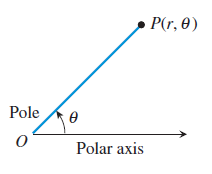
we measure as positive when moving counterclockwise and negative when moving clockwise.
If r > 0, then P is on the terminal side of θ. If r < 0, then P is on the terminal side of π+θ.
Plotting Points in the Polar Coordinate System
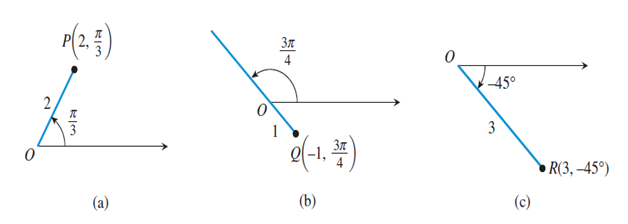
Example1.Plot the following points with given polar coordinates
a) P(2, π/3) b) Q(-1, 3π/4 ) c) R(3,-45° )
Finding all Polar Coordinates of a point
Let point P have polar coordinates (r,θ). Any other polar coordinates of P must be of the form
(r, θ+2nπ ) Or
(-r, θ+(2n+1)π ) Where n is any integer.
The coordinates (r,θ ) , (r, θ+2π), and (-r, θ+π) all name the same point.
Example2.If the point P has Polar coordinates (1.5,-20° ), then find all other polar coordinates for P
Solution: using the formula given above
(1.5, -20+2nπ )
(-1.5, -20+(2n+1)π )
These are all the coordinates of point P. Using these formulas we can find first two coordinates using n=0,1
(1.5, -20+2π ) = (1.5 , 340°)
(-1.5,-20+π ) = (-1.5 , 160°)
Coordinate conversion:
Using the following equations Polar coordinates can be converted to rectangular coordinates and vice versa .
Let P have polar coordinates (r,θ ) and rectangular coordinates (x,y), then
x = r cosθ y = r sinθ
Example3Use an algebraic method to find the rectangular coordinates of the points with given polar coordinates.
(2, 270° )
Solution: we have r=2 and θ=270
x = r cosθ y =r sinθ
x = 2cos(270) y =2sin(270)
x = 2(0) = 0 y = 2(-1) = -2
So the rectangular coordinates are (0,-2)
Example4.Convert the rectangular coordinates (-1,1) to two polar coordinates algebraically.
Solution: Given that x=-1 and y=1
So the first polar coordinates are (√2 , 3π/4 )
Other polar coordinate would be (-√2 , 3π/4 + π) = (-√2 , 7π/4)
which can also be written as (-√2 , -π/4 )
Converting equations:
Example 5. Convert the following polar equations to rectangular form and identify the graph.
a) r secθ = 3
r/cosθ = 3
r = 3cosθ
r*r= 3*r*cosθ
By completing squares,
Which is equation of a circle.
Center = (3/2 ,0)
Radius(r) = 3/2
b) r=2 sinθ-4cosθ
r*r = r(2 sinθ-4cosθ)
Which is the equation of circle.
center = (-2,1)
radius(r)= √5
Example6: Convert the following rectangular equations to polar form.
a) 2x-3y =5
2*rcosθ -3*rsinθ = 5
r(2cos -3sinθ ) = 5
b)
x^2+6x+9 +y^2 +6y+9 = 18
r^2 = -r(6cosθ +6sinθ )
r = -(6cosθ +6sinθ )
Finding Distance using Polar Coordinates
Example7. The location, given in polar coordinates, of two planes approaching the Vicksburg airport are (4mi, 12° ) and (2mi,72° ) . Find the distance between the airplanes.
Solution: let the two planes be A and B as shown in figure given below.
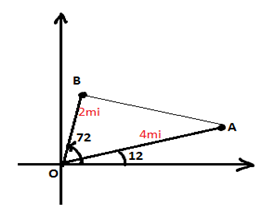
To find the distance between A and B we use cosine rule. Angle between OA and OB is given as,
θ=72-12=60°
AB = √12 = 3.46 miles
Distance between two planes is 3.46 miles.
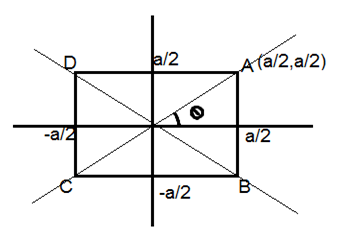
Example8. A square with sides of length a and center at the origin has two sides parallel to the x-axis. Find polar coordinates of the vertices.
Solution: A square with sides of length a and center at origin would be drawn as below.
Rectangular coordinates of vertex A are (a/2 , a/2). We find its equivalent polar coordinates.
x = a/2 , y = a/2
Polar coordinates of vertex
For all other vertices value of r remain same as sides of squares are equal just θ changes in each quadrant. In each quadrant it get increased by π/2
Practice problems:
- Find all the polar coordinates for given point P
(2, π/6 )
- Convert the following rectangular equation to polar form.
- Convert the given polar equation to rectangular form r cscθ = 1
- Radar detects two airplanes at the same altitude. Their polar coordinates are (8 mi,110°) and (5 mi, 15°). How far apart are the airplanes?
Answers :
- r=6cosθ
- 9.80 miles