De Moivre’s Theorem and nth Roots

De Moivre’s Theorem and nth  Roots

Complex plane :

Just as real numbers can be represented by points on the real number line, we can represent a complex number z= x+yi as a point (x,y)  in the complex plane.

The  horizontal axis is called real axis and vertical axis is called imaginary axis.

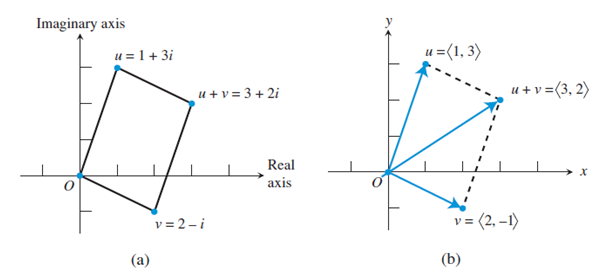
Example1. Plot u=1+3i , v=2-i , and u+v  in the complex plane. These three points and the origin determine a quadrilateral. Is it a parallelogram?

Solution:    u=1+3i  , v=2-i

u+v =(1+3i) + (2- i) =2+3i

Now we plot these  points 1+3i, 2-i  and 2+3i  in complex plane as shown below.

Figure (a) shows numbers plotted in complex plane  and figure (b) shows that arithmetic is same as in vector addition.

The quadrilateral is a parallelogram because the arithmetic is exactly the same as in vector addition.

Trigonometric Form of Complex Numbers

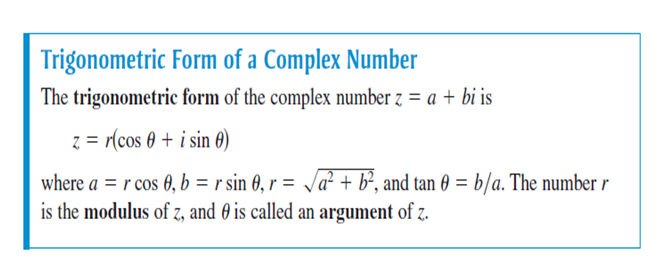
The trigonometric form of a complex number is also called the polar form.

Because there are infinitely many choices for θ , the trigonometric form of a complex number is not unique. Normally, is restricted to the interval  0≤θ≤2π  although on occasion it is convenient to θ<0.


Example2. Find the trigonometric form of the complex number where the argument satisfies 0≤θ≤2π.

                        Z = -2+ 2√3 i

Solution:  The absolute value of z is,

\dpi{120} r= \left | -2+2\sqrt{3}i \right |=\sqrt{(-2)^{2}+(2\sqrt{3})^{2}}= \sqrt{16}=4

Argument     \dpi{120} tan\theta =\frac{2\sqrt{3}}{-2}= -\sqrt{3}

\dpi{120} \theta =tan^{-1}(-\sqrt{3})= \frac{2\pi }{3}

So the polar form is

\dpi{120} z = 4\left [ cos\frac{2\pi }{3}+ isin\frac{2\pi }{3} \right ]


Multiplication and Division of Complex  Numbers

The trigonometric form for complex numbers is particularly convenient for multiplying and dividing complex numbers. The product involves the product of the moduli and the sum of the arguments. (Moduli is the plural of modulus.) The quotient involves the quotient of the moduli and the difference of the arguments.

Product of two complex numbers:

Let            \dpi{120} z_{1}=r_{1}(cos\theta _{1}+i sin\theta _{1})

And          \dpi{120} z_{2}=r_{2}(cos\theta _{2}+i sin\theta _{2})

then product is given as,

\dpi{150} \mathbf{z_{1}z_{2}=r_{1}r_{2}\left [ cos(\theta _{1}+\theta _{2})+i sin(\theta _{1}+\theta _{2}) \right ]}


Example3. Find the product    in two ways, (a) using the trigonometric form for z1 and z2 and (b) using the standard form for z1 and z2 .

Z1 = 3-2i                    Z2  = 1+i

Solution: a) we need to convert the two numbers into  trigonometric form.

For    Z1,    \dpi{120} r_{1}=\sqrt{(3)^{2}+(-2)^{2}}=\sqrt{13}

\dpi{120} \theta _{1}=tan^{-1}\left ( \frac{-2}{3} \right )=326.31

For Z2,     \dpi{120} r_{2}=\sqrt{(1)^{2}+(1)^{2}}=\sqrt{2}

\dpi{120} \theta _{2}=tan^{-1}\left ( \frac{1}{1} \right )= 45^{\circ}

\dpi{120} z_{1}z_{2}=\sqrt{13}\sqrt{2}\left [ cos(326.31+45)+i sin(326.31+45) \right ]

\dpi{120} z_{1}z_{2}=\sqrt{26}\left [ cos(371.31)+i sin(371.31) \right ]

= 4.9999 + 1.000 i

= 5 + i

b) algebraic method

Z1Z2 = (3-2i)*(1+i)

= 3 + 3i -2i -2i(i)

= 3 + i -2(-1) = 3 + i +2

= 5 + i


Quotient of Two Complex Numbers

Let        \dpi{120} z_{1}=r_{1}(cos\theta _{1}+i sin\theta _{1})

And      \dpi{120} z_{2}=r_{2}(cos\theta _{2}+i sin\theta _{2})

then quotient  is given as,

\dpi{150} \mathbf{\frac{z_{1}}{z_{2}}= \frac{r_{1}}{r_{2}}\left [ cos(\theta _{1}-\theta _{2})+isin\left ( \theta _{1}-\theta _{2} \right ) \right ] , r_{2}\neq 0}


Example4. Find the quotient   in two ways, (a) using the trigonometric form for Z1 and Z2 and (b) using the standard form for Z1 and Z2 .

                  Z1 = 3 + i                    Z2  = 5 – 3i

Solution: First  we convert the two numbers into  trigonometric form.

For Z1 ,   \dpi{120} r_{1}=\sqrt{(3)^{2}+(1)^{2}}=\sqrt{10}

\dpi{120} \theta _{1}=tan^{-1}\left ( \frac{1}{3} \right )=18.43

For Z2 ,   \dpi{120} r_{2}=\sqrt{(5)^{2}+(-3)^{2}}=\sqrt{34}

\dpi{120} \theta _{2}=tan^{-1}\left ( \frac{-3}{5} \right )= 329.04^{\circ}

\dpi{120} \frac{z_{1}}{z_{2}}= \frac{\sqrt{10}}{\sqrt{34}}\left [ cos(18.43-329.04)+isin\left ( 18.43-329.04 \right ) \right ]

= 0.54232[ 0.6509 + i 0.7591]

= 0.35 + 0.41 i

b) By algebraic method

\dpi{120} \frac{z_{1}}{z_{2}}=\frac{3+i}{5-3i}*\frac{5+3i}{5+3i}=\frac{(3+i)(5+3i)}{(5-3i)(5+3i)}

\dpi{120} =\frac{15+9i+5i+3i^{2}}{5^{2}-(3i)^{2}}=\frac{15+14i-3}{25+9}

\dpi{120} =\frac{12+14i}{34}= 0.35+0.41i


De Moivre’s Theroem

This theorem is used to raise a complex number to a power.

Let \dpi{120} \mathbf{z=r\left [ cos\theta +isin\theta \right ]}    and let n be a positive integer, then

\dpi{150} \mathbf{Z^{n}=\left [ r(cos\theta +isin\theta ) \right ]^{n}= r^{n}\left [ cos(n\theta )+isin(n\theta ) \right ]}


Example5:   Use De Moivre’s Theorem to find the indicated power of the complex number. Write your answer in standard form.

   \dpi{150} {\color{Red} (1-\sqrt{3}i)^{3}}                         

Solution:  First we need to find trigonometric form of given complex number.

Z = 1-√3 i

\dpi{120} r=\sqrt{(1)^{2}+(-\sqrt{3})^{2}}=\sqrt{4}=2

\dpi{120} \theta =tan^{-1}\left ( \frac{-\sqrt{3}}{1} \right )=\frac{5\pi }{3}

Z = 2[ cos(5π/3)  + i sin(5π/3) ]

Using De Moivre’s  theorem,

\dpi{120} z^{3}=\left [ 2\left (cos\frac{5\pi }{3}+isin\frac{5\pi }{3} \right ) \right ]^{3}

\dpi{120} =2^{3}\left [ cos(3*\frac{5\pi }{3})+isin\left ( 3*\frac{5\pi }{3} \right ) \right ]

= 8 [cos 5π  + i sin 5π ]

= 8 [ -1 + 0i] = -8


Finding nth Roots of a Complex Number


If    \dpi{120} \mathbf{z=r\left [ cos\theta +isin\theta \right ]}    , then the n distinct complex numbers

\dpi{150} \mathbf{\sqrt[n]{r}\left [ cos\left ( \frac{\theta +2\pi k}{n} \right )+isin\left ( \frac{\theta +2\pi k}{n} \right ) \right ]}

Where k= 0,1,2,3….n-1,  are the nth roots of complex number z.


Example6. Find cube roots of complex number

\dpi{120} {\color{Red} z=3[cos\frac{4\pi }{3}+isin\frac{4\pi }{3}]}

Solution: Using nth root formula,

\dpi{120} \sqrt[n]{r}\left [ cos\left ( \frac{\theta +2\pi k}{n} \right )+isin\left ( \frac{\theta +2\pi k}{n} \right ) \right ]

Plug in n=3 , r=3 and θ=4π/3

\dpi{120} \sqrt[3]{3}\left [ cos\left ( \frac{\frac{4\pi }{3} +2\pi k}{3} \right )+isin\left ( \frac{\frac{4\pi }{3} +2\pi k}{3} \right ) \right ]

\dpi{120} \sqrt[3]{3}\left [ cos\left ( \frac{4\pi }{9}+\frac{2\pi k}{3} \right )+isin\left ( \frac{4\pi }{9}+\frac{2\pi k}{3} \right ) \right ]

Now we  can find cube roots  using k=0,1 and 2

\dpi{120} Z_{1}=\sqrt[3]{3}\left [ cos\left ( \frac{4\pi }{9}+\frac{2\pi (0)}{3} \right )+isin\left ( \frac{4\pi }{9}+\frac{2\pi (0)}{3} \right ) \right ]

\dpi{120} Z_{1}=\sqrt[3]{3}\left [ cos\left ( \frac{4\pi }{9} \right )+isin\left ( \frac{4\pi }{9}\right ) \right ]

\dpi{120} Z_{2}=\sqrt[3]{3}\left [ cos\left ( \frac{4\pi }{9}+\frac{2\pi (1)}{3} \right )+isin\left ( \frac{4\pi }{9}+\frac{2\pi (1)}{3} \right ) \right ]

\dpi{120} Z_{2}=\sqrt[3]{3}\left [ cos\left ( \frac{10\pi }{9} \right )+isin\left ( \frac{10\pi }{9}\right ) \right ]

\dpi{120} Z_{3}=\sqrt[3]{3}\left [ cos\left ( \frac{4\pi }{9}+\frac{2\pi (2)}{3} \right )+isin\left ( \frac{4\pi }{9}+\frac{2\pi (2)}{3} \right ) \right ]

\dpi{120} Z_{3}=\sqrt[3]{3}\left [ cos\left ( \frac{16\pi }{9} \right )+isin\left ( \frac{16\pi }{9}\right ) \right ]


Example7. Find the cube roots of -1 .

Solution: First we write the complex number z=-1 in trigonometric form.

Z = -1 +0i = cosπ + i sinπ

The third roots of this complex number using r=1, θ=π  and n=3 is written as,

\dpi{120} \sqrt[3]{1}\left [ cos\left ( \frac{\pi +2\pi k}{3} \right )+isin\left ( \frac{\pi +2\pi k}{3} \right ) \right ]

Using k=0,1,2 we get the three cube roots as

\dpi{120} Z_{1}=\sqrt[3]{1}\left [ cos\left ( \frac{\pi +2\pi (0)}{3} \right )+isin\left ( \frac{\pi +2\pi (0)}{3} \right ) \right ]

\dpi{120} =\sqrt[3]{1}\left [ cos\frac{ \pi }{3}+isin\frac{\pi }{3} \right ]=\frac{1}{2}+\frac{\sqrt{3}}{2}i

\dpi{120} Z_{2}=\sqrt[3]{1}\left [ cos\left ( \frac{\pi +2\pi (1)}{3} \right )+isin\left ( \frac{\pi +2\pi (1)}{3} \right ) \right ]

\dpi{120} =\sqrt[3]{1}\left [ cos \pi +isin\pi \right ]= -1+0i

\dpi{120} Z_{3}=\sqrt[3]{1}\left [ cos\left ( \frac{\pi +2\pi (2)}{3} \right )+isin\left ( \frac{\pi +2\pi (2)}{3} \right ) \right ]

\dpi{120} =\sqrt[3]{1}\left [ cos\frac{ 5\pi }{3}+isin\frac{5\pi }{3} \right ]=\frac{1}{2}-\frac{\sqrt{3}}{2}i


Example8. Find the nth roots of the complex number for the specified value of n.

z = -2i   ,   n=6

Solution:    z = 0 -2i

\dpi{120} r=\sqrt{(0)^{2}+(-2)^{2}}=2

\dpi{120} \theta =tan^{-1}\left ( \frac{2}{0} \right )= \frac{3\pi }{2}           (point  lying on negative y axis)

Plugin r=2 ,  θ=3π/2    and n=6  into following formula

\dpi{120} \sqrt[n]{r}\left [ cos\left ( \frac{\theta +2\pi k}{n} \right )+isin\left ( \frac{\theta +2\pi k}{n} \right ) \right ]

We get

\dpi{120} \sqrt[6]{2}\left [ cos\left ( \frac{\frac{3\pi }{2} +2\pi k}{6} \right )+isin\left ( \frac{\frac{3\pi }{2} +2\pi k}{6} \right ) \right ]

\dpi{120} \sqrt[6]{2}\left [ cos \left ( \frac{\pi }{4}+\frac{\pi k}{3} \right )+isin\left ( \frac{\pi }{4}+\frac{\pi k}{3} \right ) \right ]

\dpi{120} Z_{1}=\sqrt[6]{2}\left [ cos\left ( \frac{\pi }{4}+\frac{\pi (0)}{3} \right )+isin\left ( \frac{\pi }{4}+\frac{\pi (0)}{3} \right ) \right ]

\dpi{120} =\sqrt[6]{2}\left [ cos\frac{\pi }{4} +isin\frac{\pi }{4}\right ]=\sqrt[6]{2}\left ( \frac{\sqrt{2}}{2} +\frac{\sqrt{2}}{2}i\right )

\dpi{120} Z_{2}=\sqrt[6]{2}\left [ cos\left ( \frac{\pi }{4}+\frac{\pi (1)}{3} \right )+isin\left ( \frac{\pi }{4}+\frac{\pi (1)}{3} \right ) \right ]

\dpi{120} =\sqrt[6]{2}\left [ cos\frac{7\pi }{12} +isin\frac{7\pi }{12}\right ]

\dpi{120} Z_{3}=\sqrt[6]{2}\left [ cos\left ( \frac{\pi }{4}+\frac{\pi (2)}{3} \right )+isin\left ( \frac{\pi }{4}+\frac{\pi (2)}{3} \right ) \right ]

\dpi{120} =\sqrt[6]{2}\left [ cos\frac{11\pi }{12} +isin\frac{11\pi }{12}\right ]

\dpi{120} Z_{4}=\sqrt[6]{2}\left [ cos\left ( \frac{\pi }{4}+\frac{\pi (3)}{3} \right )+isin\left ( \frac{\pi }{4}+\frac{\pi (3)}{3} \right ) \right ]

\dpi{120} =\sqrt[6]{2}\left [ cos\frac{5\pi }{4} +isin\frac{5\pi }{4}\right ]

\dpi{120} Z_{5}=\sqrt[6]{2}\left [ cos\left ( \frac{\pi }{4}+\frac{\pi (4)}{3} \right )+isin\left ( \frac{\pi }{4}+\frac{\pi (4)}{3} \right ) \right ]

\dpi{120} =\sqrt[6]{2}\left [ cos\frac{19\pi }{12} +isin\frac{19\pi }{12}\right ]

\dpi{120} Z_{6}=\sqrt[6]{2}\left [ cos\left ( \frac{\pi }{4}+\frac{\pi (5)}{3} \right )+isin\left ( \frac{\pi }{4}+\frac{\pi (5)}{3} \right ) \right ]

\dpi{120} =\sqrt[6]{2}\left [ cos\frac{23\pi }{12} +isin\frac{23\pi }{12}\right ]


Example9. Determine z and the three cube roots of z if one cube root of z is  1 + √3 i

Solution: Given cube root of z = 1+ √3i

Therefore,      \dpi{120} z^{\frac{1}{3}}=1+\sqrt{3}i

\dpi{120} z=\left ( 1+\sqrt{3}i \right )^{3}

After expanding cube we get,

\dpi{120} z= 1+3\sqrt{3}i^{3}+3\sqrt{3}i+9i^{2}

=  1-3  i +3  i – 9

= -8

For complex number z= -8+0i we have  r=8  and  θ=π  , n=3

Plugin these values into formula

\dpi{120} \sqrt[n]{r}\left [ cos\left ( \frac{\theta +2\pi k}{n} \right )+isin\left ( \frac{\theta +2\pi k}{n} \right ) \right ]

\dpi{120} \sqrt[3]{8}\left [ cos\left ( \frac{\pi +2\pi k}{3} \right )+isin\left ( \frac{\pi +2\pi k}{3} \right ) \right ]

Using k=0,1,2  for three cube  roots

\dpi{120} Z_{1}=\sqrt[3]{8}\left [ cos\left ( \frac{\pi +2\pi (0)}{3} \right )+isin\left ( \frac{\pi +2\pi (0)}{3} \right ) \right ]

\dpi{120} =2\left [ cos\frac{\pi }{3}+isin\frac{\pi }{3} \right ]= 2\left ( \frac{1}{2}+\frac{\sqrt{3}}{2}i \right )= 1+\sqrt{3}i

\dpi{120} Z_{2}=\sqrt[3]{8}\left [ cos\left ( \frac{\pi +2\pi (1)}{3} \right )+isin\left ( \frac{\pi +2\pi (1)}{3} \right ) \right ]

\dpi{120} =2\left [ cos\pi +isin \pi \right ]= -2+0i

\dpi{120} Z_{3}=\sqrt[3]{8}\left [ cos\left ( \frac{\pi +2\pi (2)}{3} \right )+isin\left ( \frac{\pi +2\pi (2)}{3} \right ) \right ]

\dpi{120} =2\left [ cos\frac{5\pi }{3}+isin\frac{5\pi }{3} \right ]= 2\left ( \frac{1}{2}-\frac{\sqrt{3}}{2}i \right )= 1-\sqrt{3}i


Practice problems:

  1. Find the trigonometric form of given complex number.

Z = 3i

2. Write the complex number in standard form.

5[cos(-60)+ i sin(-60)

3. Find the product Z1*Z2 and quotient Z1/Z2    in two ways,

(a) using the trigonometric form for Z1 and Z2 and

(b) using the standard form for Z1 and Z2.

Z1 = 3 + i                    Z2 = 5 – 3i

4. Find fifth roots of given complex number

Cosπ  + i sinπ


Answers:

  • 3(cos(π/2) + i sin(π/2) )
  •  \dpi{120} \frac{5}{2}-\frac{5\sqrt{3}}{2}i
  • a) 18-4i ,   0.35 +0.41i       b) same as part a


  • \dpi{120} cos\frac{\pi }{5}+isin\frac{\pi }{5} , cos\frac{3\pi }{5}+isin\frac{3\pi }{5} , cos\frac{7\pi }{5}+isin\frac{7\pi }{5},cos\frac{9\pi }{5}+isin\frac{9\pi }{5}


Leave a comment