
Graphing Sine and Cosine functions ( vertical & Horizontal Translation)
Sine and Cosine Functions
Horizontal Translation:
In the standard equation y=asin(bx-c)+d , constant c creates the horizontal translation of basic sine and cosine curves. Comparing y= aSin(bx) with y= aSin(bx-c) , we find that graph of y= aSin(bx-c) completes one cycle from bx-c=0 to bx-c =2π . By solving for x, we can find the interval for new cycle as,
Function left end point Right end point
Y= aSin(x) x=0 x =2π
Y= aSin(bx) x=0 x=2π/b
Y= asin(bx-c) x = c/b x = c/b + 2π/b
We see that period interval of old sine function y= aSin(bx) is [0,2π/b] whereas the period interval for new horizontally translated function would be
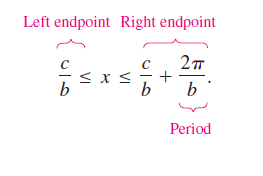
This implies that the period of y=aSin(bx-c) is 2π/b and the graph is shifted by an amount c/b. The number c/b is the phase shift.
Example1. Find amplitude ,period and phase shift for the following function and analyze its graph in terms of horizontal translation.
Y= 2Sin(x – π/3)
Solution: Comparing this equation with standard equation
y= aSin(bx-c) we get,
Amplitude(a) = 2
b=1 => period =2π/b =2π/1 = 2π
Phase shift =c/b = π/3 (right)
By solving the equations,
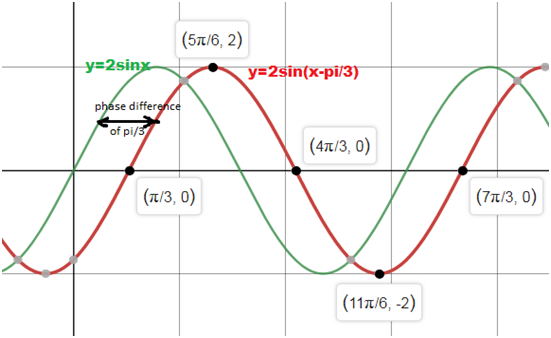
So we get new interval for one cycle as . That means complete cycle of interval [0,2π ] of y= 2sinx get shifted to right by π/3 . Now we get its 5 key points by dividing interval
into 4 equal parts and they are,
Intercept max. intercept min. intercept
(π/3,0) (5π/6, 2) (4π/3 ,0) (11π/6 ,-2) (7π/3 ,0)
By connecting these points we get the following graph.
Example2. . Find amplitude ,period ,phase shift and frequency for the following function and analyze its graph in terms of horizontal translation.
Y= -3cos(2πx+4π)
Solution: Comparing it with standard equation y= aCos(bx-c) we get, Amplitude(a)= 3
b = 2π => period =2π/b =2π/2π = 1
Phase shift =c/b =-4π/2π = -2 (left)
Frequency(f) =b/2π = 1/2π
Solving the equations,
2π x+4π = 0
2πx = -4π
x =-4π/2π = -2(left end point)
2π x+4π = 2π
2π x = -2π
x =-2π/2π = -1 (right end point)
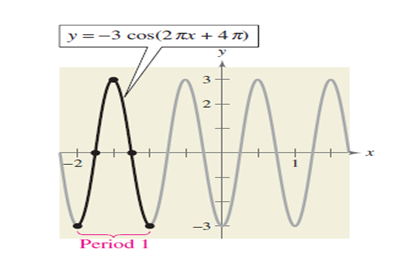
So we get the interval [-2,-1] for one cycle of graph. Now we divide this interval into equal 4 parts to get key points.
Intercept max. intercept min. intercept
(π/3 ,0) (5π/6 ,2) (4π/3,0) (11π/6,-2) (7π/3,0)
Connecting these points we get following graph.
Vertical Translation:
This type of transformation is caused by constant d in the equation y=asin(bx-c)+d.
Graph get shifted up by d units for d>0 and it get shifted down by d units for d<0.
In other words, graph oscillates about the horizontal line y=d instead of x axis.
Example: Sketch the graph of y=2+3cos2x. Also find its amplitude, period ,phase shift, vertical shift and equation of new central axis.
Solution: Comparing it with standard cosine equation
y= aCos(bx-c)+d we get,
Amplitude(a) = 3
b =2 => period =2π/b = 2π/2 = π
c =0 => Phase shift =c/b =0/b = 0
d= 2 => vertical shift = 2 units up
Equation of new central axis y= 2
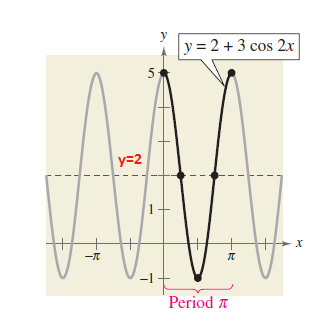
Vertical translation has the effect on y coordinates which get increased or decreased depending on value of d. Here we have the period interval [0,π ]. We divide this interval into 4 equal parts to get key points and they are:
Intercept max. intercept min. intercept
(0,5) (π/4,2) (π/2,-1) (3π/4,2) (π,5)
Connecting all these points , we get the following graph.
Practice problems:
Describe the relationship between graphs of f and g and graph them on same set of axis.
- f(x) = sin(2x)
g(x) = 3 +sin(2x)
2. f(x) = sin(4x)
g(x) = sin(4x+π) +2
3. g(x) is related to a parent function f(x)= sinx or f(x)= cosx
Describe the sequence of transformations from f(x) to g(x) and sketch the graph of g(x)
g(x)= 2sin(4x-π )-3
g(x) = cos(x-π ) +2