
Graphs of other Trigonometric functions (tanx , cotx, secx, cscx)
Graphs of other Trigonometric functions
(tanx , cotx, secx, cscx)
Tan(-x)= -Tanx
Tan(x) being an odd function is symmetric with respect to origin.
We know from the identity tanx = sinx/cosx
So tanx is undefined where cosx is 0. We know that cos is 0 at each odd multiple of π/2. Tanx will have vertical asymptotes where cosx is 0 so tanx has vertical asymptotes at each odd multiple of π/2. Also period of tan(x) is π so vertical asymptotes are
where n is an integer.
Sketching the graph of tangent functions y= atan(bx-c)is similar to sketching the graph of y=asin(bx-c) where we locate key points , vertical asymptotes and x intercepts. Two consecutive asymptotes are found by solving equations,
bx-c = -π/2 bx-c = π/2
Similarly cotx = cosx/sinx so this would be undefined where sinx is 0. As sinx is 0 at each multiple of π so cotx has vertical asymptotes at nπ where n is an integer.
Two consecutive vertical asymptotes of the graph of
y= acot(bx-c)
can be found by solving the equations bx-c=0 and bx-c =π .
Here is a summary of all properties of tan and cot functions.
| tan(x) | cot(x) | |
| Domain | |
|
| Range | (-∞,∞) | (-∞ ,∞) |
| Vertical asymptotes | |
x = nπ |
| Period | π | π |
| Symmetry | Symmetric with respect to origin | Symmetric with respect to origin |
Mid point between two vertical asymptotes is the x intercept. After plotting vertical asymptotes and x intercept we find one additional point between each asymptote and x intercept to know the direction of graph. Amplitude of tangent,cotangent functions is not defined. Lets work on some examples to understand this graphing.
Example 1. Find vertical asymptotes and x intercepts of y=-3tan(2x) and graph one complete cycle.
Solution: By solving the equations,
2x = – π/2 and 2x = π/2
x = – π/4 x =π/4
We see that two consecutive vertical asymptotes occur at -π/4 and π/4. Between these two points we find mid point which is x intercept and one point each between asymptote and x intercept as shown in table.
| x | -π/4 | -π/8 | 0 | π/8 | π/4 |
| Y=-3tan(2x) | Undef. | 3 | 0 | -3 | Undef. |
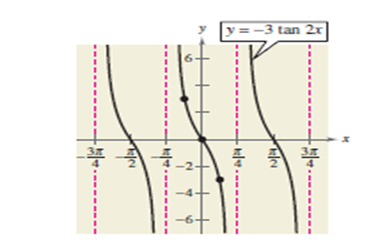
We observe that graph of y=-3tan(2x) decrease between each consecutive vertical asymptotes because here amplitude a(-3)<0.In other words graph for a<0 is a reflection in the x axis of graph for a>0.
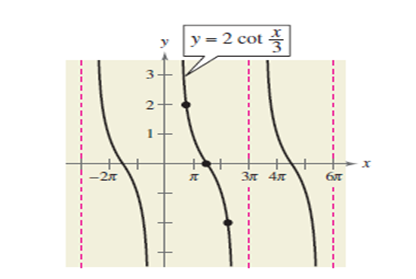
Example2. Find vertical asymptotes and x intercepts of y=2cot(x/3) and graph one complete cycle.
Solution: By solving equations,
x/3 = 0 and x/3 = π
x = 0 x = 3π
We get vertical asymptotes at x=0 and 3π . Here period is 3π which is the distance between consecutive asymptotes. Between these two vertical asymptotes we plot x intercept and other points between each asymptote and x intercept as shown in table.
| x | 0 | 3π/4 | 3π/2 | 9π/4 | 3π |
| Y=2cot(x/3) | Undef. | 2 | 0 | -2 | Undef. |
Graphs of reciprocal functions(Secant and Cosecant) :
Graphs of Secant and Cosecant can be obtained from sine and cosine using reciprocal identities.
Sec x = 1/cosx Cosec x = 1/sinx
Y coordinate of sec x is the reciprocal of y coordinate of cosx, same way, y coordinate of cosec x is the reciprocal of y coordinate of sin x for same values of x. But reciprocals doesn’t exist when sinx and cosx are 0.
The graph of secx has vertical asymptotes at x= π/2+ nπ and cosec x has vertical asymptotes at x= nπ where n is an integer.
Here is a summary of all the properties of both reciprocal functions.
| Csc(x) | Sec(x) | |
| Domain | |
|
| Range | (-∞ ,-1]U[1,∞ ) | (-∞ ,-1]U[1,∞ ) |
| Vertical asymptotes | X = nπ | |
| Period | 2π | 2π |
| Symmetry | Symmetric with respect to origin. | Symmetric with respect to y axis. |
To sketch the graph of Sec x and Cscx we draw a table of x,y values where y values are just the reciprocals of y values of cosx and sinx except at vertical asymptotes. Maximum value of sinx becomes the minimum value of cscx and minimum value become the maximum value between each vertical asymptotes. All x intercepts of sinx and cosx changes to vertical asymptotes of cscx and secx.
Lets work on a few examples to understand its working better.
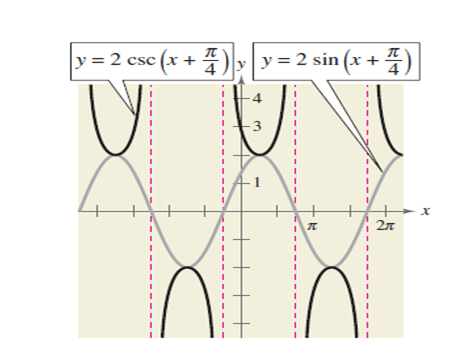
Example3. Find the vertical asymptotes and sketch the graph of
Y= 2Csc(x+π/4 )
Solution: Y= 2Csc(x+π/4 )
By solving the equations,
x+π/4 = 0 and x+π/4 = π
x = -π/4 x = π-π/4 = 3π/4
we get vertical asymptotes as etc.
which are the zeros of sin(x+π/4) . Divide the space between two vertical asymptotes using five key points and get following table of values. We get values of 2sin(x+π/4) as well as 2Csc(x+π/4 ) to understand how they are related with each other.
| x | -π/4 | 0 | π/4 | π/2 | 3π/4 | π | 5π/4 | 3π/2 | 7π/4 |
| 2sin(x+π/4 ) | 0 | √2 | 2 | √2 | 0 | -√2 | -2 | –√2 | 0 |
| 2Csc(x+π/4 ) | V.A. | 2√2 | 2 | 2√2 | V.A. | -2√2 | -2 | -2√2 | V.A. |
Plotting these points of both functions on same grid we get the following graph.
Practice problems:
- Sketch the graph of the following functions. Include two full periods.
Y = tan(4x)
Y = 2cot(x+π/2 )
Y = 2Csc(x-π)
Y = sec(3x)
Check : Draw these graphs manually using the process as explained above and then check them using graphing calculator. You can use many graphing tools available online.