
Ptolemy’s Theorem
In a cyclic quadrilateral, the sum of product of two pairs of opposite sides equals the product of its diagonals.
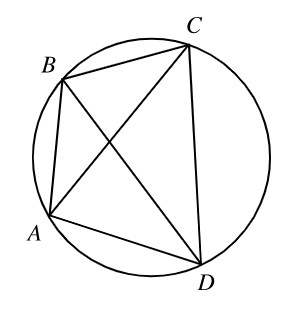
Lets work on some examples on Ptolemy’s theorem.
What is the length of chord ? Explain your answer.
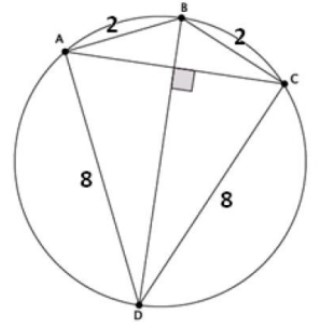
To solve this problem, we will use Ptolemy’s theorem.
For that we need to find other diagonal BD first using Pythagorean. So two cases arise here.
Case 1: BD is a diameter passing through center of circle.
Then ABD and BCD both are right triangles using Thales theorem.
[ applying Pythagorean in right triangle BAD ]
Case 2: BD is NOT a diameter.
Then ΔBAD and ΔBCD are congruent by SSS rule of congruency.
AB = BC = 2 [ given equal sides ]
AD = CD = 8 [ given equal sides ]
BD = BD [ common sides ]
[ by SSS rule of congruency ]
[ by CPCTE ]
Since ABCD is a cyclic quadrilateral , therefore sum of its apposite angles would be 180.
Here angles BAD and BCD are opposite angles of a cyclic quadrilateral and both are equal so each must be 90.
Therefore we can apply Pythagorean in any of the triangles to find side BD.
Once we have BD, we can apply Ptolemy’s theorem.
so we have,
[ by Ptolemy’s theorem ]
An equilateral triangle is inscribed in a circle, If P is a point on the circle, What does Ptolemy’s theorem have to say about the distances from this point to three other vertices ?
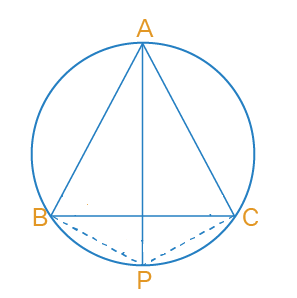
Lets join vertices B and C with point P. Now ABPC makes a cyclic quadrilateral. Ptolemy’s theorem can be applied here.
Since ΔABC is given equilateral, so we have its all three sides equal. Lets assume each side as x.
AB = BC = CA = x
Now replace AB, BC and CA with x in the first expression, and we get it as,
Dividing both sides of this equation by x, we get
Which can be summarized as under,
Larger distance, which is the distance from point P to vertex A is equal to sum of smaller distances to other two vertices.
Kite ABCD is inscribed in a circle. The kite has an area of 108 in².The ratio of lengths of non congruent adjacent sides is 3:1 . What is the perimeter of this kite?
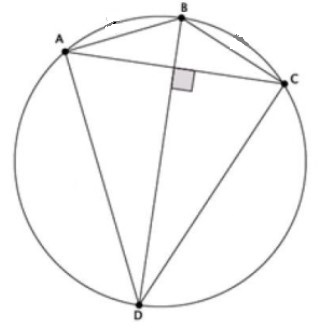
To find side length of each side of kite, we make use of Ptolemy’s theorem. But before that we need to use area of kite formula.
Given ratio of lengths of non congruent adjacent sides = 3:1
Then we can write non congruent sides AD and AB as 3x and x, where x is the common ratio.
Using Ptolemy’s theorem,
x = 6 , accepting only positive value as distance measurements can never be negative.
So all the sides of Kite are given as,
3x = 3(6)= 18
x= 6
and perimeter of kite is given as,
18+6+18+6 = 48 inches
Practice problems:
- Draw a regular pentagon of side length 1 in a circle. Let b be the length of its diagonals. What does Ptolemy’s theorem say about quadrilateral formed by four of the vertices of Pentragon ?
- Prove Pythagorean theorem using Ptolemy’s theorem.