
Thales Theorem
This is a special case of inscribed angle theorem, an important theorem of circle geometry. This theorem can be stated in any of the following ways:
If three points A, B, and C lie on the circumference of a circle, where the line AC is the diameter of the circle, then the angle ∠ABC is a right angle (90°)
OR
The diameter of a circle always subtends a right angle to any point on the circle.
OR
An inscribed angle of a triangle intercepts a diameter or semicircle if and only if the angle is a right angle.
Here is an interesting and very easy proof of Thales theorem:
To prove this we use following two facts:
– Sum of all angles of a triangle is 180.
– Base angles of an isosceles triangle are equal.

In this circle we have :
reason being all are radii of same circle.
reason being base angles of isosceles triangle OAB
Similarly ,
reason being base angles of isosceles triangle OBC
Also,
Since sum of all angles of a triangle is 180 , so
Here are some examples on Thales Theorem:
1. In the given circle FH is a diameter passing through its center J. Find x and angle HFG.
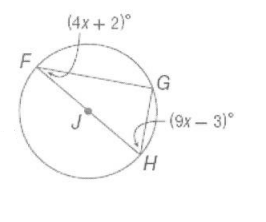
Since FH is a diameter so using Thales theorem, FGH would be a right triangle with right angle at point G.
Therefore we can apply triangle’s angle sum property,
2. In the given circle, find the measure of angle PQR . Assume point R is the center of the circle.
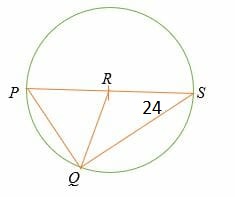
Since R is given center of circle, PS would be the diameter of the circle.
Therefore applying Thales theorem for triangle PQS, angle PQS would be a right angle.
Since RS = RQ (radii of same circle) , base angles of isosceles triangle RQS would be equal.
Also
Hence the measure of angle PQR = 66
3. In the circle shown, BC is a diameter with center A. Given m∠ABE = 26 and m∠ADB=18
Find a) m∠DAB b) m∠BAE c) m∠DAE
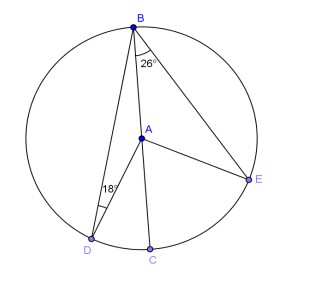
Since A is the center of circle, so AB=AD=AE , as all are radii of same circle.
Therefore ABD is an isosceles triangle and hence base angles would be equal.
Using triangle’s angle sum property,
b) Using exactly same concept for triangle ABE, we have
Using triangle’s angle sum property,
c) We see that three angles make a complete angle of 360 at point A.
4. In the figure below, O is the center of circle and AD is a diameter.
a. Find 𝑚∠𝐴OB.
b. If 𝑚∠BOC ∶ 𝑚∠𝐶OD = 6:5 , what is 𝑚∠𝐵OC?
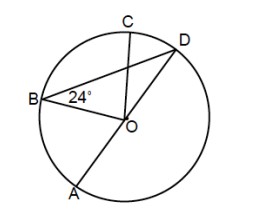
Since OB = OD being radii of same circle,
as base angles of isoscele triangles are equal.
Using exterior angle property of triangles, exterior angle is equal to sum of opposite interior angles.
b.
These two angles are given in the ratio 6 : 5
11x= 132
x= 12