Law of Sines and its Applications

Law of Sines and its Applications

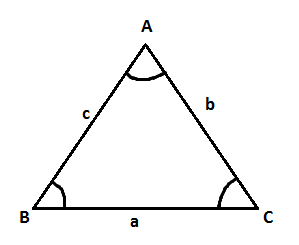
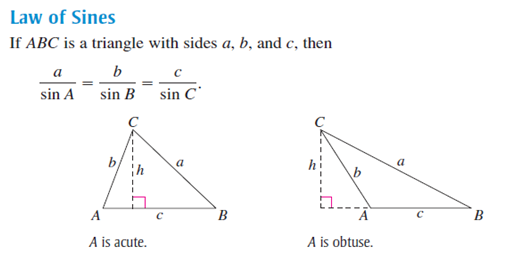
Law of Sines is used to solve oblique triangles. Oblique triangles are the triangles which have no right angles. As standard notation for law of Sines and Cosines , the angles of a triangle are labeled  as A,B and C and their opposite sides are labeled as a, b and c as shown in figure given below.


Law of Sines is used to solve the oblique triangle in any of the following two cases.

  1. Two angles and any side.
  2. Two sides and an angle opposite to one of them.


Law of Sines can also be written in reciprocal form.


\dpi{150} \mathbf{\frac{sinA}{a}=\frac{sinB}{b}=\frac{sinC}{c}}


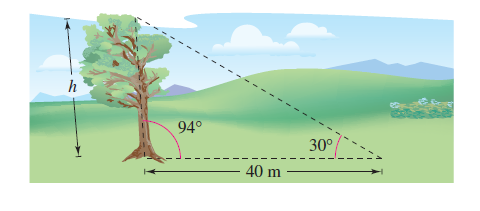
Example1. Because of prevailing winds, a tree grew so that it was leaning 4° from the vertical. At a point 40 meters from the tree, the angle of elevation to the top of the tree is 30°  . Find the height  h of the tree.


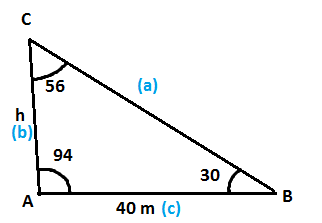
Solution: lets first get a geometrical diagram to represent the given situation.


Here we have <A=90+4=94, <B=30 , therefore using angle sum property of triangles we get,

C = 180-(94+30)= 56

Side c opposite to angle C is given 40m and  side b which is height of tree, is to be found.

By law of Sines we have,

\dpi{120} \frac{b}{sinB}=\frac{c}{sinC}

\dpi{120} \frac{h}{sin30}=\frac{40}{sin56}

h  = (40/sin56)*sin(30) =24.12m

Therefore height of tree is 24.12m


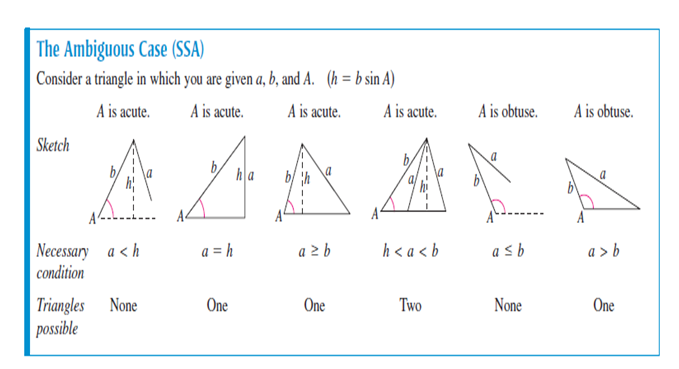
 The Ambiguous case (SSA)

If two sides and one opposite angle are given then three possible  situations can occur.

  • No such triangle exist (no solution)
  • One such triangle exist(one solution)
  • Two distinct triangle exist (two solutions)


No solution case

Example2: show that there is no such triangle for which a=15, b=25 and  A=85° .

Solution: Using law of Sines,

\dpi{120} \frac{sinB}{b}=\frac{sinA}{a}

SinB = b* (sinA/a)

SinB = 25*(sin85/15)

SinB = 1.660 > 1

Which is not possible because Sin ranges from -1 to 1, so no triangle is possible with these sides.


One solution case

Example3:For a given triangle ABC, given that a=22inches, b= 12inches  and <A=42° . Find remaining side and angles.

Solution: By the law of Sines,

\dpi{120} \frac{sinB}{b}=\frac{sinA}{a}

sinB    = b*(sinA/a)

sinB = 12*(sin42/22)

\dpi{120} B= sin^{-1}(0.36498)= 21.4^{\circ}

Now we can find third angle easily, using angle sum property of triangles.

<C = 180-(42+21.4) = 116.6°

Using two angles  and one side we can find third side,

\dpi{120} \frac{b}{sinB}=\frac{c}{sinC}

\dpi{120} \frac{12}{sin21.4}=\frac{c}{sin116.6}

\dpi{120} \frac{12}{sin21.4}*sin116.6 =c


29.40 = c


Two solutions case

Example4. Find two triangles for which a=12m, b=31m and <A=20.5°

Solution: By the law of Sines,

\dpi{120} \frac{sinB}{b}=\frac{sinA}{a}

\dpi{120} \frac{sinB}{31}=\frac{sin20.5}{12}

\dpi{120} sinB=31*\frac{sin20.5}{12}=0.9047

\dpi{120} B= sin^{-1}(0.9047)

There are two angles B1= 64.8°  and B2=(180-64.8)=115.2°   ,

So there are two possible triangle solutions.

For B1=64.8° , we get <C = 180-(20.5+64.8) = 94.7°

\dpi{120} \frac{c}{sinC}=\frac{a}{sinA}

\dpi{120} \frac{c}{sin94.7}=\frac{12}{sin20.5}

c = (12/sin20.5)*sin(94.7)

c = 34.15m

For B2 =115.2°  , we get C =180-(20.5+115.2)= 44.3°

\dpi{120} \frac{c}{sin44.3}=\frac{12}{sin20.5}

c  = (12/sin20.5)*sin(44.3)

c  = 23.93m


Area of Oblique Triangle :

The area of any triangle is one half  the product of two sides times the sine of their included angle.

\dpi{150} \mathbf{A=\frac{1}{2}bcsinA =\frac{1}{2}abainC=\frac{1}{2}acsinB}


Example5. Find the area of  triangle having  angle and sides as,

          A=43° 45’ , b=57 and c=85

Solution: First we convert the angle from degree and minutes to decimal degrees so that we can calculate sine of angle using calculator.

43°45’ = 43 + 45/60  = 43.75°

\dpi{120} Area A=\frac{1}{2}bcsinA

\dpi{120} A=\frac{1}{2}(57)(85)sin(43.75) =1675.2

A = 1675.2  sq. units


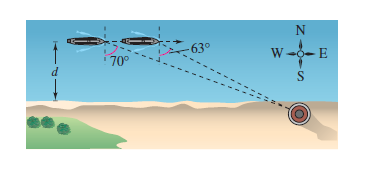
Example6. A boat is sailing due east parallel to the shoreline at a speed of 10 miles per hour. At a given time, the bearing to the lighthouse is S70°E, and 15 minutes later the bearing is S63°E. The lighthouse is located at the shoreline. What is the distance from the boat to the shoreline?


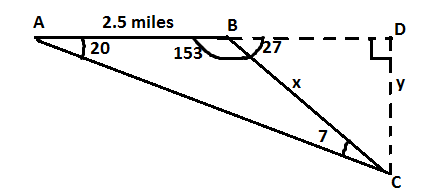
Solution: First we draw the  given situation as geometric diagram as under,


Here A,B are the two different position of boat and C is the shoreline. CD is the perpendicular distance from boat to shoreline.

To find the distance between two positions of boat A and B  we use distance =speed*time formula.

Distance AB = 10mph *(15/60)hrs

= 10*  = 2.5 miles

Angle B= 90+63 = 153°

Using law of Sines,

\dpi{120} \frac{x}{sin20}= \frac{2.5}{sin7}

x  = (2.5/sin7) *sin20

x = 7.016 miles

To find perpendicular distance between boat and shoreline we use right triangle BCD.

y/7.016  = sin(27)

y = (7.016)sin(27)

y = 3.2 miles

So the distance from boat to shoreline is 3.2 miles.


Practice problems:

  1. Use the Law of Sines to solve the triangle. If two solutions exist, find both. Round your answers to two decimal place.

A=58° ,  a=11.4,  b=12.8

  1. Find the area of triangle having angle and sides as ,

B =72°30′  a=105, c=64

  1. The angles of elevation to an airplane from two points A and B on level ground are 55° and 72° The points  A and B  are 2.2 miles apart, and the airplane is east of both points in the same vertical plane. Find the altitude of the plane.
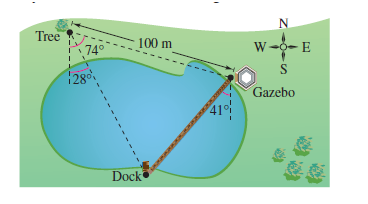
  2. A bridge is to be built across a small lake from a gazebo to a dock . The bearing from the gazebo to the dock is S41°W From a tree 100 meters from the gazebo, the bearings to the gazebo and the dock are S74°E and S28° E respectively. Find the distance from the gazebo to the dock.


Answers:

1.Two solutions:  B=72.21°, C=49.79° , c=10.27

B=107.79°, C=14.21° , c=3.30

  1. 3204.5 sq. units
  2. 5.86 miles
  3. 77m


Leave a comment