Graphing Sine and Cosine functions(stretching & shrinking)
Sine and Cosine functions (Stretching&Shrinking)
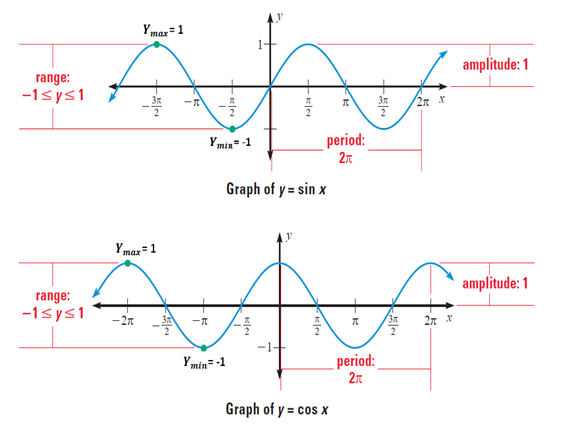
Sinx and cosx are the two basic and frequently used trigonometric functions. Their graphs have same properties. Lets have a look at these properties.
- Domain of both sinx and cosx is all real numbers (-∞ , ∞).
- Range of each function is [-1,1].
- Amplitude of each of these functions is 1.
- Each of them has same period of 2π . (Period is the length of one complete cycle here).
- Maximum and minimum values of both functions are 1 and -1 respectively but they occur at different points for each of these functions
Important terms related with graphs of trigonometric functions:
- Amplitude: It is the distance between central line and peak of the graph. Or it is the height from central line to either maximum or minimum point. Amplitude(a) is half the distance between maximum and minimum points.
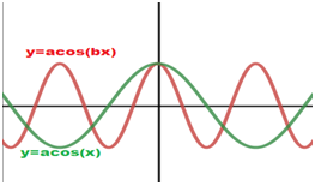
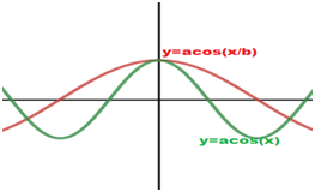
- Period: It is the time in which one cycle is completed. Horizontal length of each cycle is called period. For a function y=asin(bx) or acos(bx) , period is given by the formula,
period=2π/b
- Phase shift: Phase shift is how far a graph is shifted horizontally from its usual position. It is denoted by c so positive c means shift to left and negative c means shift to right.
- Vertical shift: This is how far a graph is shifted up or down from its usual position. It is denoted by d so +d means shifted up and –d means shifted down.
- Frequency: it is the number of cycles completed in one second. It is the reciprocal of period so its formula is given as
freq(f) =b/2π
Putting all the above terms together, we get the following equation.
Y= asin(b(x-c))+d OR
y= acos(b(x-c))+d
Using key points to sketch a curve:
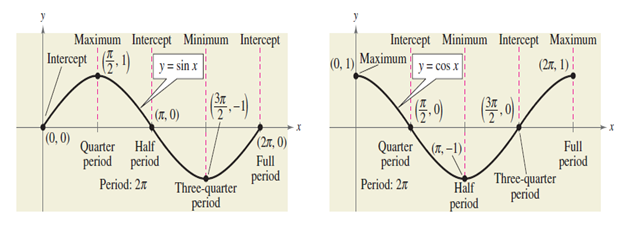
To sketch the basic sine and cosine functions by hand it helps to note five key points in one period. These key points are : intercepts, maximum and minimum points.
Example: Sketch the following function using five key points on the interval [-π , 4π]
Y = 2sinx
Solution: When we compare it with y= asin(b(x-c))+d, we see that there is no phase shift and vertical shift (c=0,d=0).
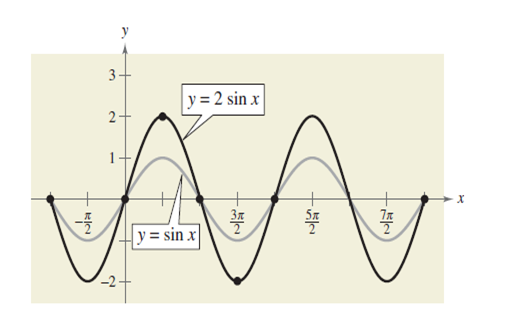
Here we have amplitude , a=2
Using b=1 , period = 2π/b =2π/1 = 2
Now we divide this period of 2π into 4 parts to get key points.
Initial point of sinx curve is (0,0) which is also x intercept.
Intercept max. intercept min. intercept
(0,0) (π/2 ,2) ( π,0) (3π/2 ,-2) ( 2π,0)
After connecting all these five points we get a smooth curve. Extending this curve in both directions over the interval [-π , 4π ] we get the graph as shown below. Graph of 2sinx is same as sinx, except amplitude get doubled.
Here is a summary of vertical and horizontal shrink and stretch and their effects on amplitude and period.
| Function | Transformation | Effected para-meters | Graphs |
| Vertical stretch | Amplitude get increased | ||
a>0 |
Vertical shrink | Amplitude get reduced | |
a>0, b>0 |
Horizontal shrink | Period get decreased | |
a>0, b>0 |
Horizontal stretch | Period get increased | |
a>0 |
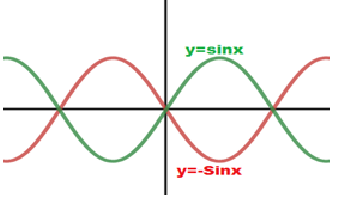
Reflection across x axis | Max. and min. get reversed |
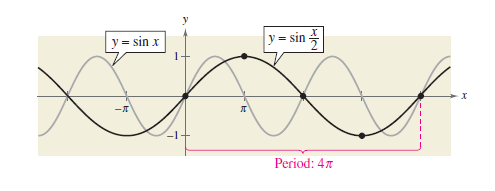
Example2. Sketch the graph of y= sin(x/2).Compare it with the graph of basic function y=sinx. How its parameters amplitude and period get effected?
Solution: Comparing the given equation y= sin(x/2) with standard basic sin function y= aSin(bx), we get
Amplitude(a) = 1 and b =1/2
So this function has period interval [0, 4π ] as compared to the basic period interval of [0, 2π ]. Now we divide this interval into 4 equal parts with values π, 2π , 3π to get five key points.
Intercept max. intercept min. intercept
(0,0) (π,1) ( 2π,0) (3π,-1) (4π ,0)
Connecting all these points , we get the following graph.
We can observe that there is no effect on amplitude but period get doubled. So there is horizontal stretch.
Same way we can draw the graphs for functions like y=sin(2x) where period get reduced by half so new period would be [0,π ]. Then we divide this period into 4 equal parts and get a graph which is compressed horizontally .
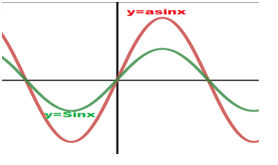
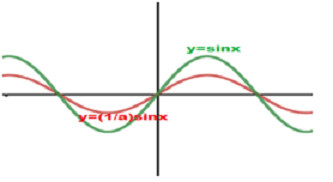
For the function y= aSinx or Y= aCosx its amplitude get increased by factor ‘a’ so there would be vertical stretch and for the function y= (1/a) Sinx amplitude get decreased by factor ‘a’ causing vertical shrink. X coordinates of 5 key points will remain same as period remain unaffected but y coordinates changed to –a and a accordingly.
Practice problems:
- Find period and amplitude for the following functions and then graph them using five key points.
- Y= Cos(2x)
- Y=-4Sin(x)
- Y= Sin(x/3 )
- Y=(1/4) Cos(x)
Answers:
amp.= 1 , period =[0 π]
amp.= 4 ,period =[0,2π ]
amp. =1 ,period= [0,6π ]
amp. = 0.25 , period= [0,2π]