Dot product of Vectors

Dot Product of Vectors

Dot product of two vectors is also called inner product or scalar product. Dot product of two vectors u=〈u1,u2〉  and v=〈v1,v2〉  is given as,

                   u.v=〈u1,u2〉.〈v1,v2〉  = u1v1 + u2v2 


Example1. Use dot product to find length of vector u= 〈4,-3〉   

Solution: From property of dot product we have

\dpi{120} \mathbf{\left | u \right |= \sqrt{u.u}}

\dpi{120} \left | u \right |= \sqrt{\left \langle 4,-3 \right \rangle.\left \langle 4,-3 \right \rangle}

\dpi{120} \left | u \right |= \sqrt{4*4 +(-3)*(-3)}

\dpi{120} \left | u \right |= \sqrt{4*4 +(-3)*(-3)}

 \dpi{120} \left | u \right |= \sqrt{25} =5


Angle between two vectors:

By the definition of dot product we have,

u.v =|u||v|cosθ

\dpi{120} \mathbf{\frac{u.v}{\left | u \right |\left | v \right |} =cos\theta }

 \dpi{150} \mathbf{\theta =cos^{-1}\left ( \frac{u.v}{\left | u \right |\left | v \right |} \right )}


Example2. Find the angle between two vectors u=〈-4 ,-3〉  and v=〈-1,5〉

Solution:           \dpi{120} \left | u \right |=\sqrt{(-4)^{2}+(-3)^{2}}=\sqrt{25}=5

\dpi{120} \left | u \right |=\sqrt{(-1)^{2}+(5)^{2}}=\sqrt{26}

u.v = (-4,-3).(-1,5) = (-4)(-1)+(-3)(5) = -11

Angle      \dpi{120} \theta = cos^{-1}\left ( \frac{-11}{5\sqrt{26}} \right )= 115.56^{\circ}


Orthogonal Vectors:

The vectors u and v are orthogonal if  and only  if

u.v =0


Example3. Determine whether u and v are orthogonal, parallel, or neither.

a) u = 〈5,3〉  v=〈-10/4 , -3/2〉                    b) u=〈-3,4〉   v =〈20,15〉

Solution:

a) Rewriting vector v, we get

v =〈-5/2, -3/2〉  =  – 1/2〈5,3〉

v = (-1/2) u

Vector v is a scalar multiple of vector u. That shows both vectors are parallel.


b) Rewriting vector v

u=〈-3,4〉   v =5〈4,3〉

u.v = 〈-3,4〉 . 5〈4,3〉

= 5 (-3*4+4*3)

= 5(0) = 0

As the dot product is 0, so both vectors are orthogonal.


Projecting one vector onto other

Example4. Find the vector projection of u onto v. Then write u  as a sum of two orthogonal vectors, one of which is  \dpi{120} {\color{Red} proj_{v}u}.

  u =〈8,5〉   v =〈-9,-2〉

Solution:           u.v =〈8,5〉.〈-9,-2〉

= 8*-9 +5*-2 = -82

\dpi{120} \left | v\right |^{2}=\left (\sqrt{(-9)^{2}+(-2)^{2}} \right )^{2}=\left (\sqrt{85} \right )^{2}=85

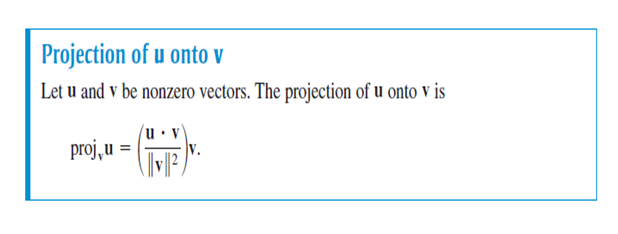
Let    \dpi{120} \mathbf{u_{1}=proj_{v}u=\left ( \frac{u.v}{\left | v \right |^{2}} \right )v}

\dpi{120} =\left ( \frac{-82}{85} \right )\left \langle -9,-2 \right \rangle=\left ( \frac{82}{85} \right )\left \langle 9,2 \right \rangle


\dpi{120} u_{2}= u-u_{1}=\left \langle 8,5 \right \rangle-\frac{82}{85}\left \langle 9,2 \right \rangle

\dpi{120} =\left \langle \frac{-58}{85},\frac{261}{85} \right \rangle =\frac{29}{85}\left \langle -2,9 \right \rangle


Thus,       \dpi{120} u=u_{1}+u_{2}=\frac{82}{85}\left \langle 9,2 \right \rangle+\frac{29}{85}\left \langle -2,9 \right \rangle


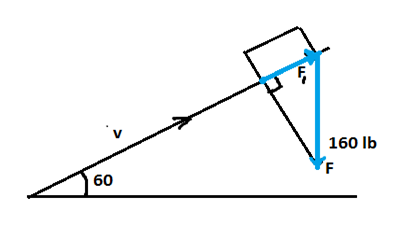
Example 5. Ojemba is sitting on a sled on the side of a hill inclined at 60° . The combined weight of Ojemba and the sled is 160 pounds. What is the magnitude of the force required for Mandisa to keep the sled from sliding down the hill?

Solution:

Since the combined weight acting downward is given 160 lb so force due to gravity is given as  F = -160j

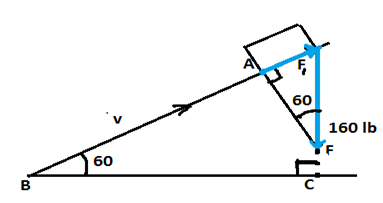
And side of hill is represented by vector v making angle 60 with horizontal as show below.


v  = cos(60)i+sin(60)j

=  (1/2) i + (√3/2)  j

The force(F1 ) required to keep the sled from sliding down the hill is actually the  projection of vector F in vector v.

\dpi{120} F.v = -160j.\left \langle \frac{1}{2}i+\frac{\sqrt{3}}{2}j \right \rangle =-160*\frac{\sqrt{3}}{2}=-80\sqrt{3}

|v| = 1

\dpi{120} F_{1}=\left ( \frac{F.v}{\left | v \right |^{2}} \right )v

|F1 | = 80√3  *1 = 138.56 pounds


Other method:


Since triangles  B C  and A F  are similar triangles by AA rule, therefore   < A F1F  = <ABC = 60

Using right triangle AF1 F

\dpi{120} \frac{AF_{1}}{F_{1}F}=sin (60)

AF1=F1F * sin(60)

AF1  = 160* √3/2  = 80√3 = 138.56 pounds


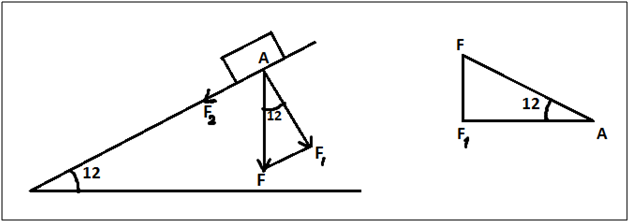
Example6. A 2000-pound car is parked on a street that makes an angle of  12°  with the horizontal (see figure).


(a) Find the magnitude of the force required to keep the car from rolling down the hill.

(b) Find the force perpendicular to the street.

Solution:

Weight of car 2000 pounds acting downwards is represented by vector F. This vector is resolved in two components. One F2  is acting along inclined plane  and other F1 is acting perpendicular to inclined plane .

a)  Magnitude of the force required to keep the car from rolling down the hill is given by F2 which can also be found by projection of F onto v.

Since F2   is parallel to FF1  so we find it using right triangle FF1A ,

FF1/FA     =  sin(12)

FF1    =  FA sin(12)

FF1  = 2000*sin(12) = 415.82 pounds


b)  Force perpendicular to street (AF1)

AF1/FA   = cos(12)

AF1 = FA cos(12)

AF1 = 2000*cos(12)

AF1  = 1956.30 pounds


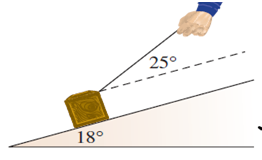
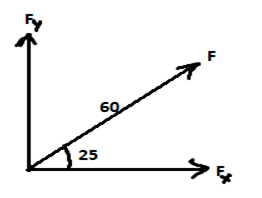
Example7. A 60-pound force F that makes an angle of 25° with an inclined plane is pulling a box up the plane. The inclined plane makes an angle 18° with the horizontal. What is the magnitude of the effective force pulling the box up the plane?


Solution:  Here effective force is parallel to inclined plane which is actually the horizontal component of force F. So we just need to find horizontal component of force.

\dpi{120} F_{x}=Fcos\theta

\dpi{120} F_{x}= 60 cos(25) =54.4 lbs


WORK :

The work done W by a constant force F acting along the line of motion of an object is given by

\dpi{150} \mathbf{W=\left | F \right |\left | \overrightarrow{AB }\right |}

If constant force F is not directed along line of motion, then work done is given by

\dpi{150} \mathbf{W=\left | F \right |\left | \overrightarrow{AB }\right |cos\theta }


The work done W by a constant force F as its point of application moves along the vector AB is given by either of the following.

  •  \dpi{150} \mathbf{W=\left | proj_{AB}F \right |\left | \overrightarrow{AB }\right |}         projection form
  •   \dpi{150} \mathbf{W= F . \overrightarrow{AB }}                                   dot product form


Example8. Find the work done lifting a 2600-pound car 5.5 feet.

Solution:

Since  force is acting along the line of motion (while lifting the car up to some distance) so we use formula

\dpi{120} W=\left | F \right |\left | \overrightarrow{AB }\right |

W = 2600 *5.5 = 14,300 ft pounds


Example9. The angle between a 75-pound force F and    \dpi{120} {\color{Red} \overrightarrow{AB}}    is 60° , where A=(-1,1) and B=(4,3). Find the work done by  F in moving an object from A to B.

Solution; Here force is not directed along line of motion but it is acting at an angle of  60°  with \dpi{120} \overrightarrow{AB}     so we use formula

\dpi{120} \overrightarrow{AB}     = (4,3)-(-1,1) = 〈5,2〉

\dpi{120} \left | \overrightarrow{AB }\right |=\sqrt{5^{2}+2^{2}}=\sqrt{29}

W = |F| |\dpi{120} \overrightarrow{AB} | cosθ

W = 75√29 cos(60)

= 75 √29(0.5)   = 201.94 ft pounds


Example10.Find the work done by a force  F  of 30 pounds acting in the direction  〈2,2〉  in moving an object 3 feet from (0,0) to a point in the first quadrant along the line y = x/2 .

Solution;

We are given distance =3 ft. along the line y= (1/2)x so we can find the other point (x,y) using distance formula.

\dpi{120} D=\sqrt{(x-0)^{2}+(y-0)^{2}}

\dpi{120} 3=\sqrt{(x)^{2}+\left (\frac{x}{2} \right )^{2}}=\sqrt{\frac{5x^{2}}{4}}

\dpi{120} 3=\sqrt{5}\frac{x}{2}

x =6/√5

Y = x/2 = 3/√5    so the other point B is  (6/√5 , 3/√5 )

The force of magnitude 30 pounds acting in the direction 〈2,2〉

\dpi{120} F= 30\frac{\left \langle 2,2 \right \rangle}{\left | \left \langle 2,2 \right \rangle \right |}=30\frac{\left \langle 2,2 \right \rangle}{\sqrt{8}}

Work done

\dpi{120} W=F.\overrightarrow{AB}= 30\frac{\left \langle 2,2 \right \rangle}{\sqrt{8}}.\frac{\left \langle 6,3 \right \rangle}{\sqrt{5}}

\dpi{120} w=\frac{30}{\sqrt{40}}(12+6)= 85.38 ft. pound


Other way:

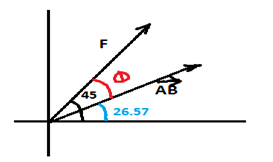
Given |F| =30 , |AB| = 3

Now we need to find angle between force and distance vectors.


Angle made by vector F

\dpi{120} tan^{-1}\left ( \frac{2}{2} \right )= 45^{\circ}

Angle made by distance vector

\dpi{120} \overrightarrow{AB}= tan^{-1}\left ( \frac{1}{2} \right )= 26.57^{\circ}

Angle between vectors F and \dpi{120} \overrightarrow{AB}

θ = 45-26.57 = 18.43°

Work done W = |F| |AB| cosθ

W = 30*3 *cos(18.43)

W = 85.38 ft pounds


Practice problems:

  1. Find the vector projection of u onto v. Then write u as a sum of two orthogonal vectors, one of which is \dpi{120} proj_{v}u.

u = 〈2,2〉      v =〈6,1〉

  1. Determine whether u and v are orthogonal, parallel, or neither.   u= 2i-2j    ,    v= -i-j
  2. Juan is sitting on a sled on the side of a hill inclined at 45°. The combined weight of Juan and the sled is 140 pounds. What force is required for Rafaela to keep the sled from sliding down the hill?
  3. Find the work done by a force F of 12 pounds acting in the direction 〈1,2〉 in moving an object 4 feet from (0,0) to (4,0).


Answers:

  1. 1/37〈84,14〉 ,  1/37〈-10,60〉
  2. orthogonal
  3. 99 pounds
  4. 21.47 ft pounds

Leave a comment