Graphs of Polar equations

How to Graph Polar equations.

Polar curves are just the special cases of parametric curves. Polar curves are graphed in the (x,y) plane, despite the fact that they are given in terms of r and θ. That is why the polar graph of r =4cosθ  is a circle.

In polar mode, points are determined by a directed distance from the pole that changes as the angle sweeps around the pole.


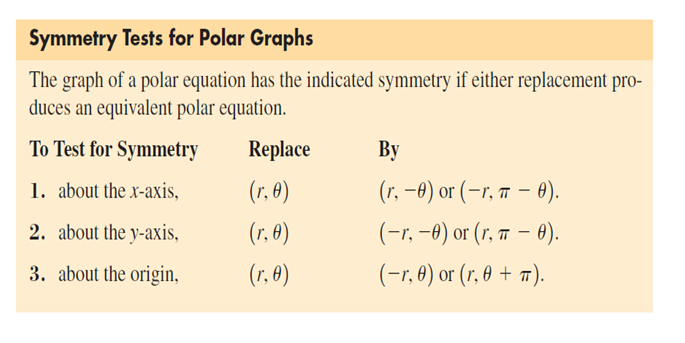
Symmetry:


There exist three types of symmetry in polar equations.

  • The x axis (polar axis) as a line of symmetry.
  • The y axis (the line θ=π/2 ) as a line of symmetry.
  • The origin (the pole) as point of symmetry.


Example1. Use the symmetry tests to prove that the graph of r=4sin(3θ ) is symmetric about the y-axis.

Solution: Replace (r,θ ) with (-r, – θ) and we get,

-r = 4sin(3(-θ ))

-r = 4sin(-3θ )

-r = -4sin(3θ )             sine as odd function, sin(- θ) =-sinθ

r = 4sin(3θ )

After replacement we get same equation as original so this polar equation has symmetry about y axis.


Graphing a polar equation

Graphing polar equation is much similar to graphing rectangular equation in (x,y) coordinates. In polar equations we assume random values of  and find r values corresponding to that and then plot those points on polar coordinate grid. Knowing symmetric tests is an advantage in graphing polar equations manually.

There are some basic shapes for polar equations. It is always helpful to have knowledge of these basic shapes before sketching polar equations.


1)  Circles in polar form:


Polar equation Description  Graph
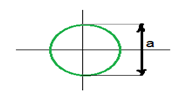
r=a Circle with center at pole and ‘a’ as diameter.
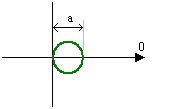
r=a cosθ Circle with diameter ‘a’ along x axis with its left most edge at pole
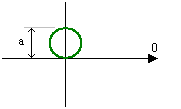
r=a sinθ Circle with diameter ‘a’ along y axis with its  bottom most edge at pole


2)  Limacons(snails)

r = a ± b sin θ, where a > 0 and b > 0

r = a ± b cos θ, where a > 0 and b > 0


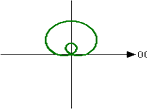
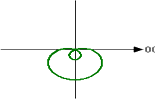
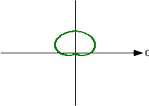
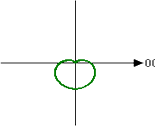
The limacons containing sine will be above the horizontal axis if the sign between a and b is plus or below the horizontal axis if the sign is minus. If the limaçon contains the function  cosine then the graph will be either to the right of the vertical axis if the sign is plus or to the left of the vertical axis if the sign is minus.

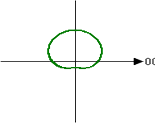
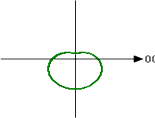
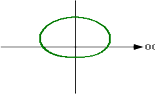
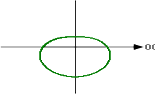
The ratio of (a/b) will determine the exact shape of the limacon as explained in this table.

r = a ± b sin θ, where a > 0 and b > 0


    Ratio(a/b )   r = a+bsinθ
(above horz. axis)
 r = a- bsinθ
(below horz. axis)  
\dpi{120} \mathbf{\frac{a}{b}< 1}
   \dpi{120} \mathbf{\frac{a}{b}= 1}
\dpi{120} \mathbf{1< \frac{a}{b}< 2}
\dpi{120} \mathbf{\frac{a}{b}> 2}


The graphs of limaçons with cosine would have similar shapes but along the horizontal axis.


Special case :  When ratio   \dpi{120} \mathbf{\left | \frac{a}{b} \right |=1}    then limacon is called cardioid.


3)  Rose curves:

A rose curve is a graph that is produced from a polar equation in the form of

r = a sin(nθ)       or

r = a cos(nθ),

where a ≠ 0 and n is an integer > 1

They are called rose curves because the loops that are formed resemble petals. The number of petals depend on the value of n. The length of the petals depand on the value of a.

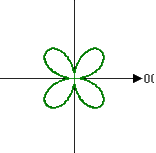
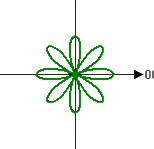
If n is an even integer, then the rose will have 2n petals as shown in following examples.


r = asin(2θ )                                        r = acos(4θ )


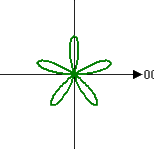
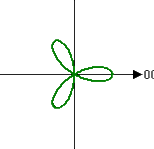
If n is an odd integer then rose will have n petals as shown in following examples.


r = a cos(5θ )                                        r= a cos(3θ )


4)  Lemniscates:

lemniscates has the shape of a figure-8 or a propeller. General polar equation of lemniscates  is given as,

\dpi{120} \mathbf{r^{2}=a^{2}sin(2\theta )}        or

\dpi{120} \mathbf{r^{2}=a^{2}cos(2\theta )}        where a ≠ 0

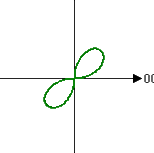
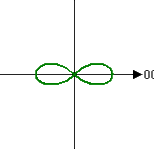
A lemniscate containing the sine function will be symmetric to the pole while the lemniscate containing the cosine function will be symmetric to the polar axis, to θ =π/2 , and the pole.


\dpi{120} \mathbf{r^{2}=a^{2}sin(2\theta )}                                                                        \dpi{120} \mathbf{r^{2}=a^{2}cos(2\theta )}


Example2. Graph the polar equation r = 4cosθ .Use the knowledge of symmetric tests to complete the graph manually.

Solution:

Step1.First we construct a table of r,θ  values. We assume random values of   but  we prefer to use standard angles. It is useful to first find those values of θ which makes values of r as maximum, minimum  and 0.

Step2.Since cosθ is even function so we check asymmetry about x axis by replacing  θ  with –θ .

r = 4cos(-θ )

r = 4cosθ                   cos  is even function so cos(-θ )= cos(θ)       

That shows  this polar equation will be symmetric about x axis. So we just get the table for values of θ  up to π . After that values of r will repeat themselves.      


 θ  0   π/6    π/4   π/3   π/2  2π/3  3π/4   5π/6    π
  r 4 3.5 2.8 2 0 -2 -2.8 -3.5 -4


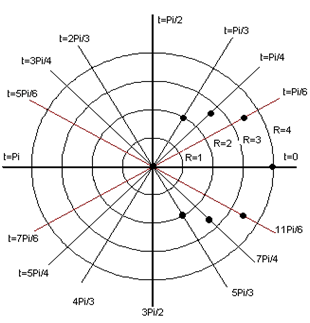
Now we plot these points on polar grid. We have to be careful while plotting negative r values. As explained in previous section, To get  negative r values  we add pi to specific θ values.

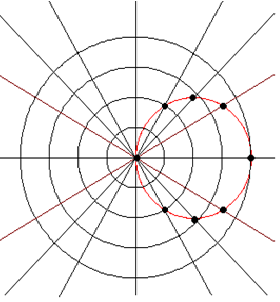
For example to plot point (-2, 2π/3  )  we get (-2, 2π/3+ π ) = (-2, 5π/3 ) as shown in graph below. Negative r values are obtained by rotating the point by 180°

(a)

(b)


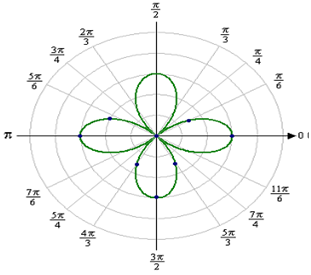
Example3 Graph the polar equation r = 3cos(2θ ).

Solution:

Step1.recognizing the equation. The polar equation is in the form of a rose curve, r = a cos nθ. Since n is an even integer, the rose will have 2n petals.

2n = 2(2) = 4 petals


Step 2. Tests for symmetry:


 Polar axis   θ = 2π   Pole
r = 3 cos 2θ

r = 3 cos 2(-θ)

r = 3 cos (-2θ)

r = 3 cos 2θ

r = 3 cos 2θ

-r = 3 cos 2(-θ)

r = -3 cos (-2θ)

r = –3 cos 2θ

r = 3 cos 2θ

-r = 3 cos 2θ

r = –3 cos 2θ

Passes symmetry test Fails symmetry test Fails symmetry test


Step 3.Now we evaluate r at different values of .


   θ  0    π/6     π/4    π/3    π/2   2π/3    3π/4    5π/6    π
  r 3   3/2   0    -3/2   -3    -3/2   0     3/2   3


These points will provide us with enough points to complete the rest of the graph  using the symmetry of the rose curve and we get the graph as below.


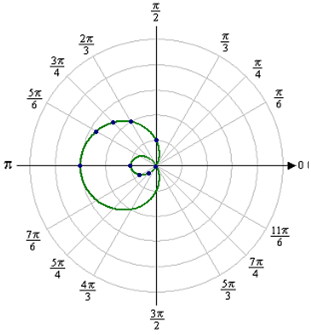
Example4.  Graph the polar equation r = 1 – 2 cos θ.

Solution:

Step1. Recognizing the equation-

The polar equation is in the form of a limaçon, r = a – b cos θ.

Find the ratio of  a/b  to determine the equation’s general shape.

a/b  = 1/2  < 1

Since the ratio is less than 1, it will have both an inner and outer loop. The loops will  be along the polar axis since the function is cosine and  to the left since the sign between a and b is minus.

Step 2. Lets check the symmetry.


Polar axis    θ = 2π   Pole
r = 1 – 2 cos θ

r = 1 – 2 cos (-θ)

r = 1 – 2 cos θ

r = 1 – 2 cos θ

-r = 1 – 2 cos (-θ)

-r = 1 – 2 cos θ

r = –1 + 2 cos θ

r = 1 – 2 cos θ

-r = 1 – 2 cos θ

r = –1 + 2 cos θ

Passes symmetry test Fails symmetry test Fails symmetry test


Step3. Find r at different value of .


   θ  0    π/6    π/4    π/3     π/2    2π/3    3π/4    5π/6    π
  r -1 – 0.73 -0.41   0   1    2   2.41   2.73   3


Using above points and symmetry  we get the following graph.


Leave a comment