Evaluating Trigonometric functions

Evaluating Trigonometric functions

In this lesson we work on finding  values of different trigonometric functions using various identities  and formulas.

We can use sum and difference formulas, half angle  and double angle formulas to evaluate the values of different trigonometric functions.

Example: Find the exact value of cos(π/12).

Solution: Here we use the fact that  \dpi{120} \frac{\pi }{12}=\frac{\pi }{3}-\frac{\pi }{4}

Then using the formula   cos(x-y) =  cosx cosy + sinx siny

\dpi{120} cos\frac{\pi }{12}=cos\left (\frac{\pi }{3}-\frac{\pi }{4} \right )

= cos(π/3 ) cos( π/4) + sin(π/3) sin(π/4 )

\dpi{120} =\frac{1}{2}*\frac{\sqrt{2}}{2}+\frac{\sqrt{3}}{2}*\frac{\sqrt{2}}{2}

\dpi{120} = \frac{\sqrt{2}+\sqrt{6}}{4}


Example: Find the exact value of sin(17π/12 ).

Solution: Here we use the fact that  \dpi{120} \frac{17\pi }{12}=\frac{9\pi }{4}-\frac{5\pi }{6}

Then using the formula   sin(x-y) =  sinx cosy – cosx siny

\dpi{120} sin\frac{17\pi }{12}=sin\left (\frac{9\pi }{4}-\frac{5\pi }{6} \right )

sin(17π/12) =  sin(9π/4)cos(5π/6) – cos(9π/4 )sin( 5π/6) ———(i)

Now we find exact values of sin(9π/4) , cos(5π/6) ,cos(9π/4)  , sin(5π/6 ) using equivalent acute angles.

\dpi{120} sin\left (\frac{9\pi }{4} \right )=sin\left ( 2\pi +\frac{\pi }{4} \right )=sin\frac{\pi }{4}=\frac{\sqrt{2}}{2}

\dpi{120} cos\left (\frac{9\pi }{4} \right )=cos\left ( 2\pi +\frac{\pi }{4} \right )=cos\frac{\pi }{4}=\frac{\sqrt{2}}{2}

\dpi{120} sin\left (\frac{5\pi }{6} \right )=sin\left ( \pi -\frac{\pi }{6} \right )=sin\frac{\pi }{6}=\frac{1}{2}

\dpi{120} cos\left (\frac{5\pi }{6} \right )=cos\left ( \pi -\frac{\pi }{6} \right )=-cos\frac{\pi }{6}=-\frac{\sqrt{3}}{2}

Plugin all these values into   —(i) we get,

\dpi{120} sin\left ( \frac{17\pi }{12} \right )=\frac{\sqrt{2}}{2}*\frac{-\sqrt{3}}{2}-\frac{\sqrt{2}}{2}*\frac{1}{2}=\frac{-\sqrt{6}}{4}-\frac{\sqrt{2}}{4}=\frac{-\sqrt{6}-\sqrt{2}}{4}


Example: Find the exact value of sin(u+v)  given that sinu=5/13  and cosv = -3/5 (Both u and v are in quadrant II)

Solution: To find value of sin(u+v) we need to  get values of sinv and cosu first,  which can be found either by using Pythagorean identities or  using right triangle. We also need to take care of signs used with sinv and cosu using ASTC rule.

\dpi{120} cosu=\sqrt{1-sin^{2}u}= \sqrt{1-\left ( \frac{5}{13} \right )^{2}}= \sqrt{\frac{144}{169}}=\frac{12}{13}

Since u is given in 2nd quadrant so cosu would be negative .

Cosu = -12/13

\dpi{120} sinv=\sqrt{1-cos^{2}v}= \sqrt{1-\left ( \frac{-3}{5} \right )^{2}}= \sqrt{\frac{16}{25}}=\frac{4}{5}         [ sinv is positive being in 2nd quadrant]

Now we can substitute the values of sinu, cosu, sinv and cosv into the following formula.

Sin(u+v) = sinu cosv +cosu sinv

\dpi{120} =\frac{5}{13}*\frac{-3}{5}+\frac{-12}{13}*\frac{4}{5}

\dpi{120} =\frac{-15}{65}+\frac{-48}{65}=\frac{-63}{65}


Example: Write the following   trigonometric expression as an algebraic expression.

Sin(arcsin x+arcos x)

Solution:    First we assume this given function as sin(u+v)

Sin(u+v) = sinu cosv + cosu sinv

Where u=arc sin x                         v=arc cosx

\dpi{120} u=sin^{-1}x                                 \dpi{120} v= cos^{-1}x

sinu =x                                              cosv =x

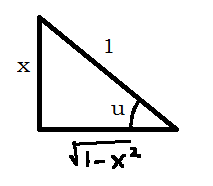
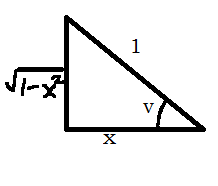
Here we can use right triangles to find values of  cosu and sinv.


\dpi{120} cosu=\frac{\sqrt{1-x^{2}}}{1}                                          \dpi{120} sinv=\frac{\sqrt{1-x^{2}}}{1}

Sin(arcsin x+arcos x) = sin(u+v) =sinu cosv + cosu sinv

\dpi{120} =x*x+\frac{\sqrt{1-x^{2}}}{1}*\frac{\sqrt{1-x^{2}}}{1}

\dpi{120} =x^{2}+1-x^{2}=1


Example: prove the identity. \dpi{120} {\color{Red} cos\left ( \pi -\theta \right )+sin\left ( \frac{\pi }{2}+\theta \right )=0}

Solution:  Using identities cos(x-y) and sin(x+y) we get,

cos( π)cosθ  + sin(π )sin(θ) +sin(π/2)cosθ +cos(π/2)sin(θ)=0

We know that    cos(π) = -1                         sin(π) = 0

cos(π/2) = 0                              sin(π/2 ) = 1

Substituting these values we get,

(-1) cosθ  + (0)sin( θ) + (1)cosθ  +(0)sin(θ) = 0

-cos(θ) +0 +cos(θ) +0 = 0

-cos(θ ) + cos( θ) = 0

0  = 0


Example:  Find exact value of the expression.

Sin 75  + sin15

Solution: To solve  this, we make use of sum to product formula

\dpi{120} sinx+siny=2sin\left ( \frac{x+y}{2} \right )cos\left ( \frac{x-y}{2} \right )

\dpi{120} sin75+sin15=2sin\left ( \frac{75+15}{2} \right )cos\left ( \frac{75-15}{2} \right )

= 2sin(45) cos(30)

\dpi{120} =2*\frac{\sqrt{2}}{2}*\frac{\sqrt{3}}{2}=\frac{\sqrt{6}}{2}


Practice problems:

  • Find the exact value of cos(13π/12).
  • Find the exact value of sin(u+v) given that sinu=-7/25  and cosv =-4/5 (Both u and v are in quadrant III)
  • Find the exact value of expression \dpi{120} cos\left (\frac{3\pi }{4} \right )-cos\left ( \frac{\pi }{4} \right )
  • Write the following trigonometric expression as an algebraic expression.

\dpi{120} sin\left [ tan^{-1}(2x)-cos^{-1}(x) \right ]

  • Prove the identity.

Cos(x+y)cos(x-y) = cos^2(x)-cos^2(y)


Answers:

  • \dpi{120} \frac{-\sqrt{6}-\sqrt{2}}{4}
  • -4/5
  • -√2
  • \dpi{120} \frac{2x^{2}-\sqrt{1-x^{2}}}{\sqrt{1+4x^{2}}}


Leave a comment